Showing posts with label philosophy. Show all posts

Monday, November 8, 2010

We See This as the Future of Higher Education

I’d like you to read this article in the New York Times titled, Learning in Dorm, Because Class is on the Web (two pages, make sure you click through to page two). Go ahead, go read it, then come back.

This article illustrates that many colleges – which most of you will be attending in 3-4 years – are starting to utilize some of the same video techniques we’re trying to use in our Algebra class. There are a variety of different ways colleges are using this, some are pretty similar to what I’m doing, others are very different (consider yourself lucky, you only have to watch 8-10 minutes of me, not an 85 minute streamed lecture!).

Note that some colleges are doing this primarily for financial reasons,
You have X amount of money, what are you going to do with it?
others are exploring whether it can be a more effective way of delivering instruction,
She said an advantage of the Internet is that students can stop the lecture and rewind when they do not understand something.
No matter the reason, it appears likely that more classes will be offered this way by the time you get to college.
We see this as the future of higher education.
So consider our Algebra class a chance not only to learn Algebra (and enjoy my amazing wit), but an opportunity to begin preparing yourself to be successful in college – and beyond – by learning how to learn through online components of courses.

Notice how some students don’t like this approach.
In a conventional class, “I’m someone who sits toward the front and shares my thoughts with the teacher,” she said. In the 10 or so online courses she has taken in her four years, “it’s all the same,” she said. “No comments. No feedback. And the grades are always late.”
This is one of the reasons why I believe hybrid classes – where there’s an online component and a face-to-face component - are perhaps currently the best of both worlds when done well (although that may change as we get better at implementing online courses). But several things have to happen in order for classes like this to work.

First, students must watch/complete the “lecture” or “content-delivery” video portion of the class outside of class. Clearly some college students – as well as some of you – are not doing this. If this part isn't done, the entire model falls apart.

Second, just as critically, students must be active participants in class to maximize the value of our time together. Students must be willing to use class time as an opportunity both to explore and to practice mathematical ideas and concepts, not as a time to sit back and be “told” or “shown” what to do. This is why I continue to try to get you guys to think more on your own, to talk and work in your groups, and to take risks in your learning, instead of simply waiting for me to show you the “right” answer.

So I’m hopeful that as we continue with this approach we all will get better at it. I need you to hold up your end of the bargain (watch/complete the videos outside of class - including the Guided Practice and Self-Check portions, complete the homework and online pre-assessments, actively participate/explore/think in class, and come in for help and to re-assess), and I hopefully will get better at structuring class to complement the video instruction outside of class. Together we can not only help you master Algebra, but prepare you to be successful learners in college and beyond.

Friday, November 5, 2010

Can't We Just Memorize a Formula to Plug Stuff Into?

I've been wanting to share something with you the last couple of days in class but just haven't had time, so I decided to just put it here on the blog instead. I'm currently reading The Myths of Innovation by Scott Berkun and I came across a couple of passages that I thought were relevant to our class. In a section of the book talking about the myth that good ideas are hard to find, he writes:
While waiting in a city park to interview someone for this book, a nearby child played with Silly Putty and Legos at the same time. In my notepad I listed how many ideas the young boy, not more than five years old, came up with in 10 minutes. Sitting in the grass, he combined, modified, enhanced, tore apart, chewed on, licked, and buried various creations I'd never have imagined. His young mother, chatting on a phone while resting her morning coffee on the park bench, barely noticed the inventive creations her toddler unleashed on the world. After being chased away for making her nervous (an occupational risk of writers in parks), I wondered what happens to us, and what will happen to this boy, in adulthood. Why, as is popularly believed, do our creativity abilities decline, making ideas harder to find? Why aren't our conference rooms and board meetings as vibrant as childhood playgrounds and sandboxes? (p. 82)

. . . To open minds and find good ideas, return to the kid in the park. What is it about his attitude that allows fearless idea exploration? Linus Pauling, the only winner of two solo Nobel Prize awards in history, had this to say about finding ideas: "The best way to have a good idea is to have lots of ideas." This sounds idiotic to most ears because it cuts against the systemic, formulaic, efficiency-centric perspective worshiped in schools and professions. It seems wasteful to follow Pauling's advice. Can't we just skip to the good ideas? Optimize the process? Memorize a formula to plug stuff into? Well, you can't. (p. 85-86).
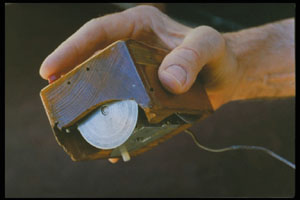
The passage also includes this picture of the first computer mouse with the caption, "The superficials of innovation are rarely impressive. This is a version of the first computer mouse."


(image source: Wikipedia)

What does this have to do with Algebra? Well, this is very similar to the philosophy of what I'm asking you to do in this class. Yes, we do have some formulas that you're going to need to learn and "plug stuff into." But our more important goal is for you to open your minds and be willing to explore ideas. This is why I'm always asking you to try to figure things out, both individually and as a group, and not wait for me to tell you how to do it.

Sure, we can "skip to the good ideas" and I can just show you how to do certain procedures, but that ends up not being very meaningful for you, and you're also not very likely to remember it very long. Instead, I want you - as much as possible - to play with the ideas. To be curious, and creative, and try to figure things out and find patterns and methods on your own, including exploring various real-world applications of the mathematics. And, yes, that's harder than just memorizing the formula and doing random problems out of the book. But I think it's also much, much, much more worthy of your time.

As Eric Hoffer said,
In a time of drastic change it is the learners who inherit the future. The learned usually find themselves equipped to live in a world that no longer exists.
I want you to be a learner; to take the attitude of "fearless idea exploration." In my class, in all your classes, and in life in general.